
The Story of the Palace Gardens
The Katterburg complex (the original name of Schönbrunn) was initially a hunting ground for the rulers of the House of Habsburg. Emperor Maximilian II ordered the creation of enclosed gardens where various animal species lived, serving as targets for the ruler’s recreational hunting.
The Palace in the 17th Century
In 1605, Hungarian military forces invaded Austria and destroyed the gardens at Schönbrunn. Emperor Matthias later restored them, returning the gardens to use for recreational hunting. After him, Emperor Ferdinand II took ownership of the complex, and it became a favorite for him and his wife, Eleonora, a lover of art and hunting.
After Ferdinand II died, Eleonora received Schönbrunn as her residence and ordered the construction of new, more magnificent and formal gardens, which she used for social events and parties. The palace gardens remained a venue for major events under subsequent rulers but suffered damage at the end of the 17th century after the Ottoman siege of Vienna.
Fortunately, the complex was soon renovated, and a magnificent structure—though never fully completed—along with Baroque-style gardens, was established. The garden designer was Jean Trehet, a student of the famous French garden designer André Le Nôtre. The gardens included many beds in symmetrical shapes, and large symmetrical paths at whose intersections were small water pools. In the heart of the garden, there was also a maze (a very common element in gardens from the Baroque period) as well as a covered garden for growing fruit trees.
The Palace in the 18th Century
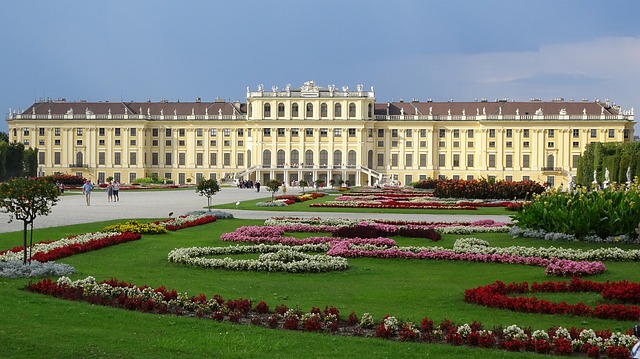
At the beginning of the 18th century, Maria Theresa received the Schönbrunn complex as a gift from her father. She was known for her affection for the palace and its gardens and therefore decided to invest in and develop them further. During her reign, the gardens expanded, and wide paths lined with diverse and beautiful vegetation were added. Maria Theresa saw the gardens as an inseparable part of the palace, so it was important to her that the gardens be as magnificent as the palace itself.
Emperor Franz Stephan, Maria Theresa’s husband, loved natural history and ordered the creation of a Dutch botanical garden in the western part of the palace garden complex (originally part of the nearby village of Hietzing), along with greenhouses and a private zoo for himself.
By 1760, extensive renovations of the palace and its gardens were complete, but one area still remained quite deserted and lacking charm. This place is the green hill opposite the palace and gardens. Although Johann Ferdinand Hetzendorf von Hohenberg, the royal house’s talented architect, prepared detailed plans for magnificent gardens on the hill, Maria Theresa did not approve the plan. Instead, she ordered the construction of a fountain at the foot of the hill (the Neptune Fountain), as well as the construction of the Gloriette structure at its top.
The hill itself remained largely unchanged except for a winding path that led to its top. At the same time, the gardens in the palace grounds were renovated and a variety of mythological statues, the Obelisk Fountain, the Beautiful Spring, and the Small Gloriette were added to them.
The palace gardens opened their doors to the general public in 1789, about a year before Maria Theresa’s death.
The Palace in the 19th Century
At the end of the 19th century, the royal family expanded their diverse plant collection and the greenhouses built by Franz Stephan, replacing them with a large greenhouse called the Great Palm House. The royal house’s last addition to the Schönbrunn complex was another greenhouse, the Desert House, where some plant species from the Habsburgs’ Dutch collection were grown.
Today, the gardens welcome daily crowds of visitors, displaying their full glory. Wonderfully preserved and maintained, they vividly convey the power and wealth of the Habsburg family. The gardens are also open during the winter months, although the fountains in them do not operate from mid-October to mid-April. You can visit any day and wander around the palace grounds; entry to this area is free.
What can you see in the Palace Gardens?
Walking in the palace gardens is free and enjoyable, especially on a hot summer day. You can sit in the shade throughout the gardens and enjoy the peace and quiet. In the palace gardens, you can also see greenhouses that grew fruit trees and plant species from around the world, a maze and playground complex, the Great and Small Gloriettes, Roman ruins, fountains, statues, and memorials. Also, the Vienna Zoo and the Carriage Museum are considered part of the palace gardens.
The Orangery and Fruit Tree Garden
The Orangery was established back in the days of Wilhelmina Amalia and was used for growing fruit trees, and in the days of Emperor Franz Stephan, it was expanded even further. It is 189 meters long and 10 meters wide, making it one of the two largest Baroque-style orangeries in the world (the other is at Versailles). Hot air ducts under the floor heat the building, allowing fruit trees to grow even on frozen winter days.
In addition to cultivating fruit trees, the Orangery hosted events and celebrations for the House of Habsburg.
It is interesting to know that until 1744, there were large vineyards in the area in front of the Orangery. A few years ago, a group of Austrian winegrowers decided to restore the vineyards and plant vines on an area of 1000 square meters. Today, you can buy the unique wine made from Schönbrunn grapes at auctions, with the proceeds donated to SOS Kinderdörfer, an organization supporting homeless children.
The Great Palm House
The Great Palm House is located where the Dutch botanical garden used to be. The greenhouse is 113 meters long. Its central space rises to a height of 28 meters, and next to it are two slightly lower structures (25 meters). Inside the greenhouse rooms, there are several climate zones: a “cold” room in the northern part, a moderate temperature in the central room, and a tropical climate in the southern room.The flow of hot air regulates the different temperatures, allowing the cultivation of plant species from around the world.
The structure itself amazes, especially given its large size and the period in which it was built. In fact, it is the last structure of its kind built in Europe.
The Gloriette on Schönbrunn Hill
Opposite the magnificent palace is an equally spectacular structure located on a beautiful green hill. This is the Gloriette, built during the reign of Maria Theresa in 1775. It was destroyed during World War II and restored in 1947 and again in 1995. A Gloriette serves as a grand garden pavilion, used as a hall for events, a magnificent dining room, or simply to enjoy a stunning view of the gardens and the city.
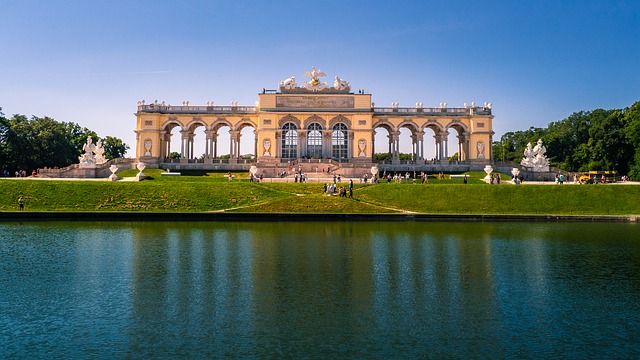
The dining room, which was in use until the end of the Habsburg rule, now serves as a café, and on the roof of the building, you can stand and watch the magnificent view of the city of Vienna. To go up to this area, you must pay an entrance fee. Details are further down in the article.
The Desert House
Emperor Franz Joseph I used this greenhouse to cultivate plant species brought to him from Australia and South Africa. The greenhouse reached completion in 1904 in a fin-de-siècle style with Art Nouveau elements. Today, the greenhouse serves as an exhibition space for rare plant species from the Madagascar region and several deserts. The exhibition is part of the Vienna Zoo, and therefore a visit to the Desert House requires payment of an entrance fee to the zoo.
The Roman Ruins
The Roman Ruins, or in their original name, the Ruins of Carthage, are located at the foot of the wooded hill of Schönbrunn. Johann Ferdinand Hetzendorf von Hohenberg designed and built this exhibit in 1778. These are artificial ruins that serve as a kind of picturesque garden and blend in wonderfully with the palace gardens.
The artificial ruins include a square pool surrounded by stone walls decorated with wall carvings, Roman columns, and a large arch above them. In the heart of the pool, there are several statues symbolizing the river gods – the Danube and the Enns.
As the original name suggests, the construction of the site was likely an illustration of the Roman Empire’s victory over Carthage, as the Habsburgs always claimed to be the legitimate heirs of the Roman emperors. Therefore, some believe that the Roman Ruins served as a kind of expression of the Habsburgs’ lineage.
Main Fountains
Throughout the gardens, there are several magnificent fountains. The most prominent among them are the Obelisk Fountain and the Neptune Fountain.
Obelisk Fountain
This fountain is located at the foot of Schönbrunn Hill, at the eastern end of the path that crosses the gardens diagonally. The fountain was built as early as 1777 and is impressive in its beauty. At the top of the fountain stands an obelisk column, hence its name. In its upper part, there is a statue of a head with an open mouth from which the fountain’s water flows down into the central pool. The various stone carvings and statues placed in the fountain symbolize the Habsburgs’ aspiration for governmental stability and absolute control over their empire.
Neptune Fountain
Undoubtedly the central and most impressive fountain of the palace gardens. The fountain was built in the days of Maria Theresa at the end of the 18th century. It is also located at the foot of the hill on which the Gloriette stands. Excavation shaped the site, and a retaining wall rose next to the hill, now decorated with beautiful vase statues.
In the center of the fountain, on what looks like a rock, stands the statue of the sea god Neptune with his trident in his hand. To his left is a statue of a nymph, and to his right, the sea goddess Thetis kneels and begs him to bless the journey of her son, Achilles, who set out to conquer Troy.
At the foot of the rock, tritons—half-human, half-fish creatures—form part of Neptune’s entourage.
This fountain also symbolizes the Habsburgs’ aspiration for control and their rule over the fate of the empire’s subjects.
The Beautiful Spring (Schönbrunn)
In the eastern corner of the park is the statue of the Beautiful Spring. This is a structure with semi-circular open arches on its front and back, built at the end of the 18th century.
In the back of the structure, there is a statue in the image of Egeria (a mythological goddess) leaning over a small body of water. She holds a vase under her arm from which the spring water flows. This is one of the most graceful statues in the Schönbrunn gardens. On one of the walls of the structure, the letter M appears, marking the name of Maximilian II, who purchased the Schönbrunn complex at the end of the 16th century.
Memorials
Throughout the gardens, there are several memorials for members of the Habsburg family.The “Family Monument” stands as a symbol of Maria Carolina, Maria Theresa’s daughter, escaping Napoleon’s army. Another memorial located south of the Desert House depicts Franz Stephan. Maria Theresa ordered the construction of this monument after the sudden death of her beloved husband, Franz Stephan. The last noteworthy monument is that of Joseph II, built at the beginning of the 19th century in recognition of the emperor’s actions to preserve and expand the botanical gardens after his father’s death.
Important Statues Throughout the Gardens
When Maria Theresa chose the design of the hill opposite the palace, she also renewed the garden complex and added a variety of statues of mythological figures. The the statues were placed at the end of the 18th century. Throughout the park, 32 statues stand, marked from 1 to 32 to make them easier to identify.
The Small Gloriette
In the heart of the forest on Schönbrunn Hill is the Small Gloriette, right next to the Maria Theresa Gate. This two-story, tower-shaped structure, built around 1775, includes several balconies and likely served as a viewpoint over the city. On the ground floor, you can see Rococo-style design.
Additional Essential Information for Your Visit
The gates of the Schönbrunn Palace gardens open every day at 6:30 AM. Entry to them is free, but if you want to enter attractions such as the Maze, the Privy Garden, or the Orangery and Palm House, you must purchase tickets separately.
Garden Opening Hours: 6:30 AM until 5:00 PM in winter. In summer, open until 8:00 PM / 9:00 PM.
Read more about the history of Schönbrunn Palace or about the most recommended attractions in the palace complex.